THE EUROPEAN MECHANISM OF STABILITY (ESM)

It is important to understand what happened on the approval of the European Mechanism of Stability by the Italian Parliament.

Note from the translator: the European Mechanism of Stability is a private financial organization from Luxembourg established on September 2012. It was thought as a loan mechanism for the European countries struggling with debt problems. It was heavily dismissed by the Italian public opinion as a loan sharking system.

The difficult political controversies on the ESM had a great impact on the public opinion, as it is very difficult now to distinguish the truth from multiple suggestions. The European Parliament approved the ESM on March 2011. It is now clear that political, financial and ideological problems are not dissolved. These concerns are based on the conflict between pro-European and anti-European activists, or – better to say – from opposed conceptions of what the European Union is and what its economic policies are. This aspects are now strongly leaving Italy amid controversies, especially in between the parliamentary majority and the opposition.

As I am a History scholary, but not an Economist, I would avoid the technical aspect of the problem, giving a small contribution to the topic relying to a timeline basis. The ESM was approved between 2011 and 2012, hence in the years of the Berlusconi and Monti Cabinets.

  • The draft law on the approval of ESM ( sept 2011) was made by the Berlusconi Cabinet, in which Giorgia Meloni, the incumbent leader of Brothers of Italy, was the Ministry of Youth. The government was backed by Berlusconi’s political pary, a.k.a. The People of Freedom, the Northern League and the Autonomy Movement. The Northern League voted against the ESM on the occasion of its approval from the European Parliament.
  • The ESM was approved by the Italian Parliament in 2012 during the time of Monti Cabinet. The Norther League, then led by Roberto Maroni, voted against it.
  • The majority of Berlusconi’s People of Freedom voted for the ESM, but some members voted strongly against. Guido Crosetto, one of the founders of Brothers of Italy, was among the dissenters.
  • The party known today as Brothers of Italy still did not exist. This measure was a step forward to the split amid the Berlusconi’s party, in which the sovereignists decided to found another party. This decision effectively took place some months after.
  • Giorgia Meloni, the incumbent leader of Brothers of Italy, was not a Minister of Monti Cabinet and did not vote for ESM. She was absent for the ballot.
  • The Democratic Party, then led by Bersani, voted massively for the ESM.

At the end the ESM was definitely approved by the will of the then Italian PM Mario Monti with the decisive approval from the Bersani led Democratic Party and the Berlusconi led People of Freedom. The latter split in two in the aftermath of the vote and led to the birth of a new party named Brothers of Italy.

Sources (In Italian)

Further clarifications

Further controversies concerns the role of Tremonti, the then Ministry of Economy for the 4th and last Berlusconi Cabinet, who signed the draft law in 2011. Giuseppe Conte, former PM of Italy in 2020, accused Tremonti of being the promoter of ESM alongside with Berlusconi in 2010.

In Giulio Tremonti’s own word (from TPI https://www.google.com/amp/s/www.tpi.it/economia/tremonti-conte-mes-eurobond-20200411584180/amp/):

Conte always mentions Eurobonds, but doesn’t know of its history. I was in favor of a Solidarity Fund, a State-saving Fund [ESM, ed], funded precisely by common debt issuance at European level, the Eurobonds. In those months, at the Eurogroup mentioned by you, I pursued that goal by winning some partners. It’s proved by an article published by the Financial Times on December 6th, 2010 and signed by Giulio Tremonti and Jean-Claude Junker. The title was: โ€œEurobonds would end the crisisโ€. As the solution to end crisis, we offered the opportunity of the Eurobond issuance in order to finance a State-saving Fund. Loans to countries under stress would have been hit by the issuance of common European assets. We did not offer to balance this help with Draconian measures as the ones made by the Troika, thanks to which we noticed a devastating impact on Greece. It was the kind of ESM to which I was then working on. I would never signed a treat imposing the Troika. And I didn’t do it.

Giulio Tremonti

Translated from Italian by
Marco Di Caprio

The Radical-Chic Cultural Hegemony

Invented by the Italian philosopher Antonio Gramsci, the sociological concept of Cultural Hegemony, which is practiced by the ruling class with the control of media, explain very well the spread of so-called political correct ideas, such as homophobia, gender theory and inclusion. Power pretends to appear always tolerant and good to the people.
By the way, I think that the radical-chic supporters of these theories adopted some Socialist and Anarchist values since 1968 as an extreme form of paradoxical ideological strategy. They speak about inclusion but, on the contrary, they are excluding people with different ideas on immigration, globalization, religions, etc. by doing so. It is a huge anti-democratic process.

Translated by
Marco Di Caprio

SILVIA ROMANO AFFAIR

Note from the translator: Silvia Romano is an Italian aid worker who was kidnapped in Kenya from the well-known terrorist group Al Shabab. During her detention, she converted to Islam and adopted the name of Aisha. 1


In the article of May 10th published on Famiglia Cristiana (Christian Family, an Italian magazine in the Catholic mold) after Silvia’s liberation from the terrorists, Alberto Pellai praises the strenght e the fortitude of Silvia Romano as a model for our youth.2
The same Pellai, in an article of May 11th (the day after), explains the conversion of the young aid worker as an effect of the well known “Stockholm syndrome”, which doesn’t fit the idea of strength of mind and character. At the end of the article, he confirms his opinion on the admirable Silvia’s strength (even though the text is smaller in this part).3

Regardless of the Stockholm syndrome, the conversion to Islam can be hardly considered a showdown from a christian. And above all, we should consider that the Roman Catholic Church has been constantly praising the firmness of the martyrs for the faith.
Last but not least, we should consider that 250 millions ca. of Christians are still persecuted for their faith, especially in Muslim countries, and they pay a very high price of blood in order to remain faithful to the Christ.

Translated by
Marco Di Caprio


Notes

1 Italian aid worker kidnapped. BBC News. Archived from the original on May 10, 2020.
2 Alberto Pellai, La forza di Silvia Romano. Famiglia Cristiana. Archived from the original on May 10, 2020. (In Italian)
3 Alberto Pellai, Silvia Romano e la Sindrome di Stoccolma. Famiglia Cristiana. Archived from the original on May 11, 2020. (In Italian)

THE BASILICA OF SAN VITALE IN ROME

The Paleochristian Basilica (minor basilica precisely) of San Vitale in Rome share the same name of the one in Ravenna, Italy, but it is relatively less known. It is located on Via Nazionale, but significantly below the street level. It is near the Palace of Expositions and not so far away from the Church of Saint Paul Inside The Walls (which is located on the opposite side). A staircase links the church to the street.

The lifetime of the Saint, to whom the Church is officially dedicated since 595, is still: Saint Vitale lived in the 1st century or maybe between the 3th and the 4th century. It is not easy to distinguish truth from legends in the lives of the Saints. We know that Vitale was a soldier from Milan and he was martyred in Ravenna, probably at the beginning of the 4th century.

Historical background

The Church of San Vitale was built at the beginning of the 5th century on a previous oratory dedicated to the Martyrs Gervasius e Protasius (Saint Vitale’s sons), transformed in a basilica with three naves during the pontificate of Innocent I (401-417).
The precise date of consecration is uncertain and can be placed shortly before or after the famous sack of Rome by the Visigoths occurred in 410.

In that historical moment the real fall of the Western Roman Empire occurred under the event of the Barbarian invasions, with a great advance rather than the official date of 476.
Since Diocletian’s times Rome was no longer the Capital (intended as the Imperial seat) or at least it was no longer the sole Capital of the Wester Empire (definitely split in two after the Emperor Teodosius’s death in 395), since it shared this role with Milan, anyway keeping a moral supremacy. In 402 the Emperor Honorius moved the official capital from Milan to Ravenna, considered unassailable because of the swamps. Gregorovius said in the Middle Ages, in the first volume of the Roman History, that the monuments of Rome were on the way of decadence even before the sack of Alaricus of 410 che dal punto di vista dei monumenti. The Basilica of San Vitale was erected in a partly crumbling City, in which Christian vestiges were still limited. Actually Gregorovius was sure that the devastation made by Visigoths had been overrated for a long time.

In the first place the Basilica was known as “titulus Vestinae” (the seat of Vesta) in the name of the Roman lady who left all her goods for the construction of the place of worship. At the time it was a very common kind of denomination, which came from the Roman habit of writing on a plate (titulus) the donor’s name of a public building. The list of the plates (titulus) is found on the Synod of 499, a very important source of information on the history of the most ancients Roman churches.

Saint Vitale was renovated several times over the centuries and was profoundly transformed.
Pope Sixtus IV (1471-1484) made the first major renovations and removed the side naves in the 15th century. Clues of this radical transformations can be seen on the right side of the nave. On the portal, equipped with large wooden doors sculpted in the 17th century, there is the coat of Sixtus IV, which features the oak of his family heraldry and one inscription reminding of his renovation.
A large Paleochristian porch was erected before the church, made of five arcades of the 5th century. After the transfer of ownership from the Pope Clement VIII to the Jesuits in 1595, the porch was closed and transformed in a vestibule. Works made in the 30s restored it.
The arches were originally as many as the doors: a very rare example of an ‘open’ facade.

The Church interiors, despite the large renovations made over the centuries, by which we should consider the one made by Pope Pius IX in 1859, are evocative and harmonious. It is incredible the atmosphere of calm and tranquility, evoked by this sacred dimension, which is clearly separated by the chaos of Via Nazionale. The cause is that the Church is below the street level. The charm is made by a particular combination: a simple structure (one nave with two aisles sideways) and the decorations, which are based on a unitary project, both for the subject and for the Mannerist style, very defamed and loved at the same time.

The fundamental theme of the cycle of frescoes, made by the painters Ciampelli, Ligustri and Commodi on the verge of 17th century, is the martyrdom; it is clear the comparison with Saint Stefano Rotondo. Both the churches turned to the Jesuit’s control on the 16th century, hence the representation of martyrdom has a pedagogical function: the Jesuits, during their missionary work both in Pagan countries and Protestants, should be ready for the supreme sacrifice. The ideological aspects should not be overlooked: during the controversies with the Reformed churches, which praises the faith over the works, the martyrdom was seen by the Counter-Reformation as the greatest human work with a view to the eternal salvation. This applied both for Jesuits and the faithful.

Considered the analogies with Saint Stefano Rotondo, the difference in approch cannot be overlooked. In the other church, based on the Caelius hill, Pomarancio the painter (to be exact Niccolรฒ Circignani in order to avoid the confusion with the other two painters with the same name) wished to stress the horrifying and bloody aspect of the martyrdom.
The frescoes of Saint Vitale are very different because of the more relaxed atmosphere. The artist Agostino Ciampelli, relatively known painter of the Mannerist artistic movement, strictly avoided the emphasis on the stoning and the blood on the paintings located in the transect.

Ten noteworthy landscapes, attributed to the relatively less known artist Tarquinio Ligustri, are located on the naves walls. Maria Barbara Guerrieri Borsoi wrote in the Dizionario Biografico della Treccani (Biographic Dictonary of the Treccani Encyclopedia): โ€œPrecise documentary sources allow us to date the decoration of the Church of San Vitale to the year 1599. The critics now agree, except Bailey (2003), to attribute to him the ten large landscapes with scenes of martyrdom. This landscape, with a similar trait to Paul Bril’s works, dominates the little human figures, conferring a historical trait to the events in order to emphasize the tragic, with irregular shapes and almost unreal. Frescoes on the presbytery are less certainty attributed to him . A payment for unknown works occurred [to him] in 1603.โ€

Frankly, my personal aesthetic impression diverges from this opinion without detracting from the unquestionable expertise of this scholar and without detracting from the unquestioned authority of the Treccani encyclopedia. The beautiful landscape does not increase a tragic feeling in my soul , but it lead me to a sense of metaphysical peace.

I am not the only one who noticed the same.

“The landscape prevails substantially on the representations, in a peaceful and undisturbed view, where the martyrdom takes place. The choice of this representation is very uncommon for the times, because at the time of Jesuits terrifying scenes of horrible torments were preferred. The main scene here is the untouched nature, the theater in which the martyrdom occurs. It is carved in the scenario as it was the most precious stone to be extracted from this jewel. The landscape view is a reference to the world, to the Creation, to the symbol of the Lord’s work, who attends peacefully to the serene course of his plan. The view of the natural environment is not clear, the context appears to be almost puzzling, in order to be deciphered: it is a training of iconography, which helps us to remember in a subtle way that our human vision is not perfect since it lies in its earthly strict limitation (Viviana Cuozzo, from the site of Parrocchia di S. Vitale).”

โ€‹Translated by
Marco Di Caprio

Sitography (In Italian)

https://it.wikipedia.org/wiki/Basilica_di_San_Vitale_(Roma)

https://romanchurches.fandom.com/wiki/San_Vitaleโ€‹https://it.wikipedia.org/wiki/Vitale_di_Milano

https://it.wikipedia.org/wiki/Titulus

http://www.treccani.it/enciclopedia/tarquinio-ligustri_(Dizionario-Biografico)/

http://www.annazelli.com/basilica-di-san-vitale-via-nazionale-roma.htm

https://www.romasegreta.it/monti/via-nazionale.html

http://massolopedia.it/curriculum-vitae-2/

Bibliography:

Aside from the essential Red Guide of the Touring Club, I suggest Claudio Rendina’s Le Chiese di Roma for the Italian speakers.
The brochure available in the Church is very useful both for pilgrims and tourists.

MONUMENTAL COMPLEX OF SAINT AGNES OUTSIDE THE WALLS

The Monumental Complex of Saint Agnes Outside the Wall (Sant’Agnese Fuori le Mura) includes the remains of the Basilica of Constantine sacred to Saint Agnes the Martyr (4th century), the Mausoleum of Santa Costanza (4th century) and the Basilica of Honorius (7th century). Its history is very complicated.

We can simply dividing its history in the following 5 stages:

  • Monument construction on the grave of the Martyr, known as Catacomb of St Agnes
  • Mausoleum and Basilica construction by Constantia, Constantine’s daughter, in near the grave
  • Pope Honorius I (625-638) renewed The Basilica, which featured three naves with a narthex. posta esattamente sul sepolcro della Martire, da parte di papa Onorio I ; The entry and exit of the pilgrims was located below the matronea.
  • On the 15th century a new access was built near the narthex
  • On the 17th century it was excavated the hill covering the lower part of the facade , which was adorned of two portals. The complex was renovated with the building of two lateral chapels.

From a historical and artistic point of view, this Complex has very important features to admire: the mosaics of the Mausoleum, which are typical of the Hellenistic period; The mosaic located in the apse of the Honorian Basilica, expression of a 7th century Byzantine style, which glorifies the Virgin and St Agnes the Martyr.

Translated by
Marco Di Caprio

VILLA TORLONIA

Main Entrance of Villa Torlonia

Villa Torlonia is an important Roman villa with sorrounding gardens. The main entrance, located on Via Nomentana, is not the original one. After the widening of the main street the entrance was moved to the actual location and built in a way that resembled the Propylaea of the Acropolis in 1910. It is similar to the Vittoriano, which was opened in 1911 (the fifthies anniversary of the Italian Unification). The works are both characterized by a Classical monumentalism.

The Villa was built around the 17th century, when the area was still wild. In 1673, infatti, the land was acquired by a member of the Pamphilij Family , the Cardinal Benedetto. In 1797 it became property of the wealth Torlonia Family, of French heritage, which didn’t belong to the Roman aristocracy. and della ricchissima famiglia Torlonia, di origine francese e quindi non appartenente alla nobiltร  romana. The Torlonias reached an important status in the City thanks to their wealth, the purchase and the renovation of the Villa. They had the chance, for this reason, to rise in the Roman aristocracy. Since ancient times the importance of a family was strictly bound to the possession of large green areas, the famous Gardens, with monumental buildings, statues and fountains.

Casino Nobile

The most important building of Villa Torlonia is the Casino Nobile, located on a hill in front of the main entrance on Via Nomentana. It was mainly used to welcome visitors and to hold parties and cerimonies. After the purchase of the Villa, the banker Giovanni Raimondo Torlonia entrusted architect Giuseppe Valadier with the project of the general property renovation. After the death of Prince Giovanni Torlonia (1829), the renovation project was commissioned to Caretti, which is the responsable of the final shape. The Casino Nobile was built in a Classical style, according to the trends of that era. Actually it resembles a Pagan temple with tympanum and bas-reliefs standing above a structure made of bossage. Torlonia Family needed a work that marked the power of their own wealth.

Another remarkable site is the so-called Casina delle Civette, which was the house of Prince Giovanni Torlonia Jr until his death in 1938. It was built in the 19th century by Giuseppe Jappelli and commissioned by the Prince Alessandro Torlonia. The Casina is a tuff made structure resembling the British rustic architecture: it was designed as a quiet shelter for the family, hidden from a hill to the main Palace.

Casina delle Civette

Translated by
Marco Di Caprio

For more Info (In Italian)..https://massolopedia.it/villa-torlonia/

THE GLAD STREET OF POPE SIXTUS V

The Church of Trinitร  dei Monti, where the Glad Street begins

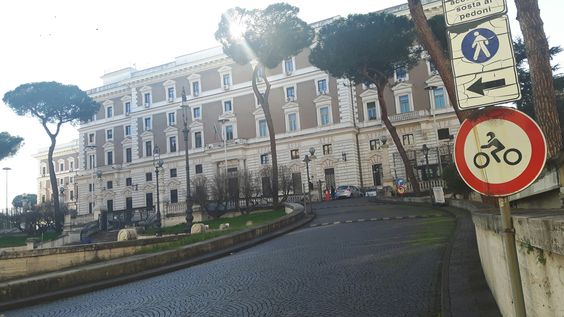
The Glad Street of Pope Sixtus (1585-1590) begins in Piazza di Spagna on the top of the stairs. It was designed in order to convey the Pincian Hill to the Basilica of Santa Croce in Jerusalem. This avenue was built in order to improve the viability of the area and to help the pilgrims visit. It is still very important today, even if its creator is remembered only for a part of that, Via Sistina, that took its name from him. The Palazzo del Viminale, seat of the Italian Ministry of Interior and until 1961 of the Government, was built between 1911 and 1925 in Via Agostino Depretis, which is the last part of the Glad Street.

On this street it is located the Church of Trinitร  dei Monti, which was constructed around 1502 and consecrated after several years by the Pope Sixtus V. The staircase was designed by Domenico Fontana, the great architect behind the construction of the Glad Street. The Sallustian obelisk, so called because it belonged to the Sallustian Gardens, was there erected 200 years later (1788) by the Pope Pius VI Braschi (1775-1799).

Palazzetto Zuccari

Just before taking Via Sistina, we spot the facade, modified in the 18th century by Filippo Juvarra for Maria Casimira Sobieski, of the so called โ€œPalazzetto Zuccariโ€, built at the end of the 16th century by the Mannerist painter Federico Zuccari.  Now it’s the home of “Biblioteca Hertziana”.

       The entrance on Via Gregoriana is very interesting. The bizarre decoration, inspired by the Gardens of Bomarzo, fueled fantasies and fears. The building is known as The Palace of the Monsters.

The entrace of Palazzetto Zuccari

If we proceed on Via Sistina, we find the Church dicated to the Saints Ildefonso and Thomas of Villanova, which is located near Piazza Barberini. It was built in the Baroque style by Spanish monks devoted to Saint Augustin during the 17th century. It was abandoned in the 18th and 19th century and later restored. Inside the Church a sculpur of the Adoration is remarkable made by Francesco Grassia in 1670.

The Church of the Saints Ildefonso and Thomas of Villanova in Rome

In Piazza Barberini it is possible to visit The Tritone Fountain made by Gian Lorenzo Bernini

Continuing on the Glad Street path it is remarkable the Church of St Andrew (Sant’Andrea degli Scozzesi)

Sant’Andrea degli Scozzesi

Then we admire Palazzo Barberini

The Quattro Fontane

Quattro Fontane

On Via Agostino Depretis, the last part of the Glad Street, there is the Palazzo del Viminale (the Viminal Palace) seat of the Ministry of Interior

In Piazza dell’Esquilino there is the obelisk erected by Pope Sixtus V in 1587. On the background it is possible to observe the apse belonging to the Basilica of Santa Maria Maggiore, a 17th century masterpiece of Carlo Rainaldi.

The Obelisk of Sixtus V

Here it ends the Glad Street.

Translated by
Marco Di Caprio

THE STADIUM OF DOMITIAN

The Stadium of Domitian, sometimes called improperly Circus Agonalis e Circus Alexandrinus, perfectly fits the area of Piazza Navona in Rome. Actually the buildings sorrounding the square were build above the ancient structures, which were used even as marble quarry of building materials, as it happened for the construction of Palazzo Braschi at the end of the 18th century. The complete overlap of the Stadium and the Square can be appreciated on the north side, nearby Tor Sanguigna: a great entrance arch is dominated by a modern bulding, constructed with attention to the old structures released thanks to recent archaeological excavation, which enabled the demolition of some worthless and shabby buildings erected there.

The word Stadium comes from the Greek stadion, the unit of measure that stood approximately for 625 feet. The fast run was held in this space and it was considered some the most important athletic contest at the time, along with wrestling, boxe and the so called “pancratium” (a mix of wrestling and boxe). The Stadium was used, at least during certain times, for gladiatorial games, as it was marked on a coin issued by the Emperor Septiumius Severus
It is important to not confuse the Stadium, location of the athletics, with the Circus, which was longer and narrower with an identical structure, as it was the stage for chariot races. The Stadium was absolutely devoid of jails and obelisks.

Considering the ancient topography, the Stadium was built in the area of Campus Martius, already covered by monuments, near the Baths of Nero.
The site is located 16 feet below the street level. The Stadium of Domitian is the first one made of bricks. Previously, on the occasion of the games claimed by the Emperors, temporary wooden structures were built (as it was explained by Roman historians Svetonius for Caesar and Cassius Dio for Augustus).

Domitian, fond of athletics, issued the Certamen Capitolino Iovi in 86 AD, a sort of Roman Olympic Games which was to be held every 4 year ogni 4 anni, and perhaps the Stadium was built some time before.
It is larger than the Palatine Stadium, built as well by Domitian and completed some time before in 92 AD.
(If you understand Italian, you can make a comparison: http://massolopedia.it/stadio-palatino/)

Stadion Domitian Nord.jpg
Immagine tratta da Wikipedia: https://commons.wikimedia.org/wiki/Category:Stadium_of_Domitian_(Rome)?uselang=it#/media/File:Stadion_Domitian_Nord.jpg

The external facade looked very impressive: it consisted of a double row of archs laying on pilasters, the lower with Ionic coloums, the upper with Corinthian coloums, with a total height of 60 feets.
The building structure is made of a porch, corridors, stairs made of pillars and one large arena. Under the buildings of Piazza Navona it is possible to visit the remains of the Stadium.
The structure is made of both travertine and bricks.
The interior walls were, and to a small extent are today, covered of stucco.
Several statues decorated the Stadium. Among those it was possible to admire Patroclus and Menelaus, later discovered in Piazza Navona.
Hagiographic sources reports that Saint Agnes was martyred iin a brothel located inside the Stadium in 305 AD, in the same site that now hosts the Church of Saint Agnes of Piazza Navona.
It is believed that the Stadium structures were recognisable, despite the debacle of the Fall of the Roman Empire, until the end of the Middle Ages, when marble quarries were set on the area to fulfil the need of marble for new constructions.
The 15th century marked the reborn of the Urban planning and a lot of building materials were needed.
In 1477, during the Pontificate of Sixtus IV, the square became the place of a great weekly market, replacing the previous market alle pendic on the slopes of the Capitol Hill.
The Stadium was concealed with the great urbanization happened between the 16th and the 18th century, which superimposed Churches and buildings above the Stadium. The arena was left free from construction despite of the erection of three fountains.
After centuries of oblivion, the ancient structure was rediscovered in 1868.
The archaeological excavation, made in the 30s, brang to light the site which now can be visited.

Translated by
Marco Di Caprio

Sitografia:
https://stadiodomiziano.com/the-stadium/archeologica-area/

http://www.sovraintendenzaroma.it/i_luoghi/roma_antica/monumenti/stadio_di_domiziano

https://it.wikipedia.org/wiki/Stadio_di_Domiziano

http://massolopedia.it/stadio-palatino/

Bibliografia:
De Cola-Galluzzi-Giovannetti, Guida dello Stadio di Domiziano e di Piazza Navona

F. Coarelli, Roma

PORTA PIA

The facade of Porta Pia

Porta Pia is an important gate, famous, obviously, because of the Capture of Rome, happened on September 20th 1870. The Italian army broke entered Rome through this gate, defeated the troops of the Papal State and completed the Italian Unification process.

The importance of Porta Pia lays beyond this event. The reason is that the Gate is one of the last – or perhaps the last – Michelangelo’s ouvres. This is incredibly a very less known fact.
Near the Gate, you can spot the Aurelian Walls and the Monument to the Capture of Rome, which changed the destiny of the Eternal City. In few yards we have many signs of the History of Italy and Rome. Last but not least, the Ministry of Economics took over the 18th Century remains of Villa Patrizi for its own building as well.

Porta Pia was built by Michelangelo in order to repeal the function of the ancient Porta Nomentana on the Aurelian Walls (now closed). It happened on the initiative of Pope Pius IV Medici (1599-1565), between 1561 and 1565.
The aim of the Pope was to improve the viability after the rapid urbanization of the area, which made Porta Nomentana unfit to be used. Precisely, the Pope wanted a more appropriate roadbed for the boulevard, which took from him the name of Via Pia (now Via XX Settembre). The pontiff wanted to directly connect its own residence on the Quirinale hill with Via Nomentana. This urban regeneration project started in the 15th century in order to optimize the transports of goods and the pilgrim visits.

We don’t have the original Michelangelo’s project and we still are unable to determine if the elderly Master could have managed the Gate construction personally. It was probably assigned to his disciples and collaborators. For sure, Michelangelo died (1564) before the completion, run soon after by his disciple and collaborator Jacopo del Duca, who supervised the works at the Church of Santa Maria degli Angeli, another masterpiece.

In the first place we admire that Porta Pia, which was fortified for difensive reasons, outstands the line of the Wall: this feature enhances the visual impact.
The facade projected by Michelangelo is open to the inner city and to the present Via XX Settembre. In order to make a comparison, we can assume that the monumental part of Porta San Paolo (dating back to the 5th century) addresses the outer city, toward Via Ostiense. The same is for Porta San Giovanni, which is a later work. The Red Guide of the Touring Club explains that Porta Pia is a ‘transition ouvre to the Baroque, because of a freedom of invention which renews the Urban Gate model, already unsual to address the inner city‘. The design of Porta Pia can be releated to the movement of Mannerism, the historical and artistic trends after the Renaissance and before the Baroque. Francois Nizet considers it a “Baroque forerunner”. It is very interesting the fusion between the Classical model with the imaginative decoration.

On the gate, we can admire a paten covered by a stole remembers trays and towels used by barbers. Based on a ironic interpretation, there is even a cube-shaped soap. Michelangelo could have hint at a popular tradition by which Pope Pius IV belonged to a family of enriched barbers from Milan. Michelangelo’s revenge was caused by the disrespectful manner of the Pope when he asked the estimate to the Master, as if he was an unknown artisan. The Pope was a Milan born Medici: no ties has been found between the Milan and the Florence based Medici family. Apart from that, on the gate there is the Medici coat of arms, which proves a close political relationship between the two families.

Michelangelo’s original project

The facade is made of bricks and is adorned by precious battlements. It is divided by a travertine portal with grooved pilasters and a composite tympanum. The double row of the windows is very interesting: below larger windows with a tympanum, above smaller windows which a rich frame. Above the main compact body it is possible to notice a thinner structure that from afar it could look like a tower in line with the central portal.

The Medici coat of arms is flanked to by two masculine and muscled angels, clearly in Michelangelo’s style and sculpted by Nardo de’ Rossi. Pope Pius IX coat of arms is carved out with an epigraph that reminds of the attic reconstruction, probably damaged by a lightning 200 years before and made by Vespignani in 1853.

The backside of Porta Pia (Wikipedia Commons)

In 1869 the backside in Neoclassical style was made by Virginio Vespignani, Pope Pius IX’s great architect, decorated by two statues that shows Saint Agnes and Saint Alexander, damaged during the Capture of Rome and there relocated in 1929. The Pope thought that the two Saints saved his life while he was visiting the collapsing Convento di S. Agnese in 1855.

Translated by
Marco Di Caprio

Sitography:
https://it.wikipedia.org/wiki/Porta_Pia

https://www.romasegreta.it/castro-pretorio/porta-pia.html
https://www.roma2pass.it/porta-pia/
http://www.treccani.it/enciclopedia/papa-pio-iv_%28Dizionario-Biografico%29/
https://www.turismoroma.it/it/luoghi/porta-pia
Photos:
http://massolopedia.it/porta-pia/
On Porta San Paolo:
https://www.youtube.com/watch?v=O8gTwM-7rW8
On the Aurelian walls:
http://massolopedia.it/le-mura-aureliane/
On Rome in general:
http://massolopedia.it/category/roma/

Bibliography:
It is always useful the precise and concise Red Guide of the Italian Touring Club and La Grande Guida di Roma by Claudio Rendina (In Italian).

MADONNA ADVOCATA OF PALAZZO BARBERINI

Madonna Advocata (“Haghiosoritissa”) of Palazzo Barberini (11th-12th centuries AD) has all the typical characteristics of the Middle Ages sacred art. This artwork is related to Early Christian art, which is derivative of Plebeian Roman tradition.

File:12th-century unknown painters - The Madonna as Advocate (Haghiosoritissa) - WGA23862.jpg
Immagine tratta da:https://commons.wikimedia.org/wiki/File:12th-century_unknown_painters_-The_Madonna_as_Advocate(Haghiosoritissa)_-_WGA23862.jpg


It is possible to observe that the folds of Jesus’s neck and the eyebrow of Mary are typical of the Byzantine art.
Obviously, this style, made of 2D pictures and hieratic stability, reached the greatest spread in the Eastern Roman Empire and it influenced Italic Art very deeply until the 12th century.
Apart from those considerations, some features of this style are bound to the “Roman School”: it shows the link, never ceased, to the Ancient Roman art. Scholars observed that it is a monumental and tipically Roman artistic research (Vodret).

Sitografia:

http://theartgalleryintheworld.blogspot.com/2017/11/scuola-romana-seconda-meta-del-xii.html?m=1

http://massolopedia.it/arte-mediovale/

http://massolopedia.it/arco-di-costantino/

https://it.m.wikipedia.org/wiki/Arte_plebea

Bibliografia:
L. Mochi Onori, Rossella Vodret, “Palazzo Barberini”, ed. Gebart 1998, p.16